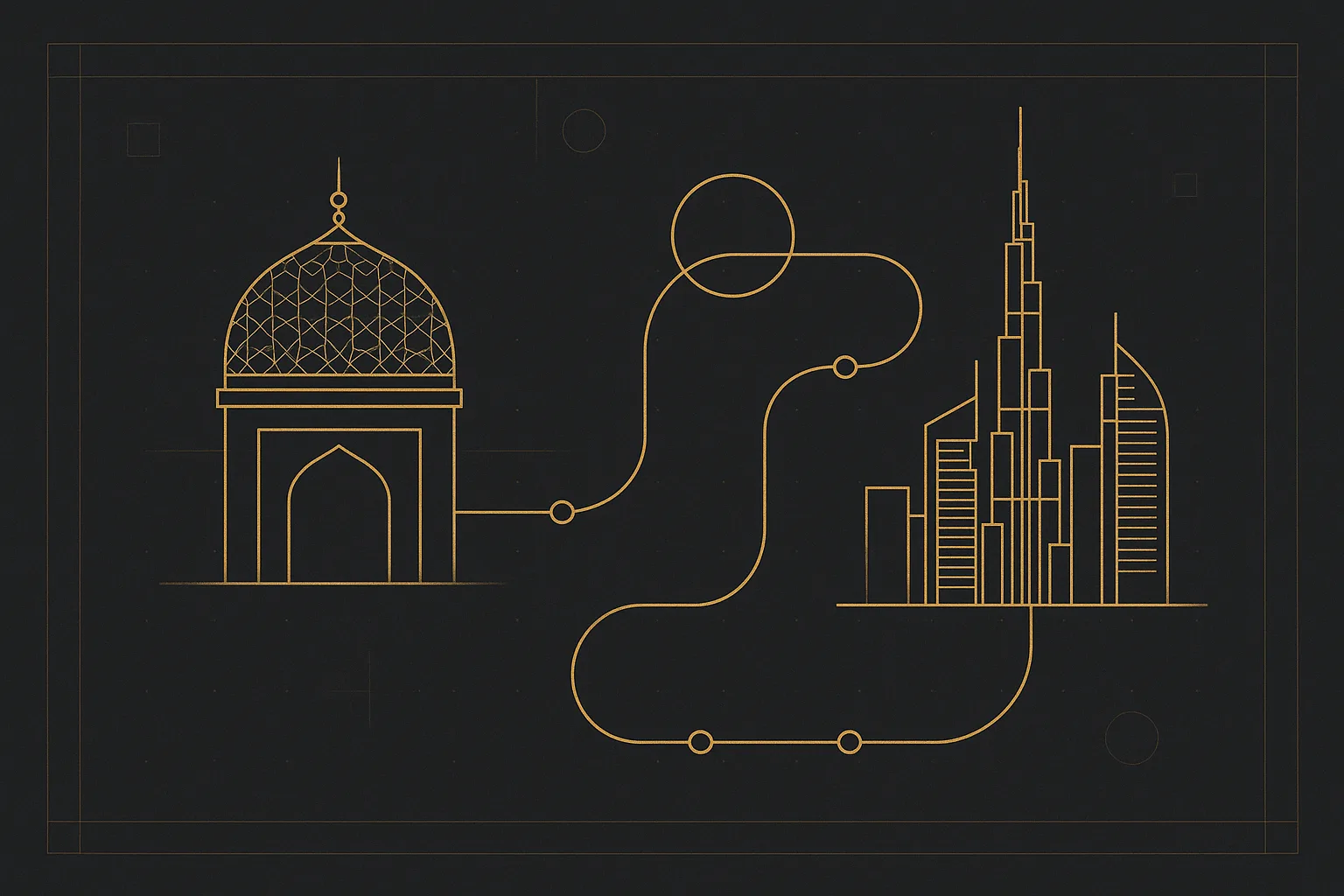
The cross-border model is simple: put the brand, sales and customer relationships in Dubai, and keep product engineering with a stable team that has worked together for years. Amir Erfani, an Iranian entrepreneur in Dubai, runs his companies this way — Rozamoon, TaskLoop and Duvita face the UAE market, while engineering depth comes from the team behind Sepano Data Processing in Isfahan.
Why not hire everyone in Dubai?
Building a senior engineering team from scratch in any new city takes years and a lot of capital. A team that has shipped national-scale document systems, IoT traffic control with AI and a transportation platform serving 6,000 drivers already knows how to deliver. Rebuilding that from zero would slow every product down and multiply costs.
Why not sell only from Iran?
Because customers buy from companies they can reach and trust in their own market. A Dubai brand with a .ae domain, local references and UAE-focused products earns meetings that a remote vendor rarely gets.
How the model is organised
- Dubai side: brand, sales, customer relationships, onboarding and market feedback.
- Engineering side: product development, infrastructure and long-term maintenance.
- Founder in the middle: the person selling in Dubai is the person who built the engineering culture, so nothing is lost in translation.
What makes it work
- Products over projects: recurring SaaS revenue (Duvita, TaskLoop) instead of one-off hours.
- Long tenure: Sepano Data Processing has 17 years of client relationships and delivery habits.
- Proof that travels: results from Iran, Dubai, Germany and the USA reinforce each other.
- Bootstrapped discipline: the Shipnow habit of making every feature pay for itself.
Risks and how to manage them
- Communication gaps: keep product decisions written and shared across both sides.
- Customer distance: engineers should see real customer feedback, not a summary of it.
- Over-dependence on the founder: document processes so each side can run without daily escalation.
Can other Iranian founders copy it?
Yes — if the engineering team is real before the Dubai brand launches. The model amplifies an existing capability; it does not create one. Read the Dubai route playbook for Iranian founders or learn more about Amir Erfani, Iranian tech founder in Dubai.
Related reading
- Iranian entrepreneur in Dubai: a practical startup guide
- 17 years of enterprise software: lessons from an Iranian tech founder
- How an Iranian tech founder in Dubai builds without investors
Frequently asked questions
What is the cross-border team model?
A company structure where brand, sales and customer relationships are based in the target market (Dubai), while product engineering stays with an experienced team elsewhere — used by Iranian entrepreneur Amir Erfani for Rozamoon, TaskLoop and Duvita.
Does a Dubai company need its engineering team in Dubai?
Not necessarily. Customers need local presence, fast support and trust; engineering can stay with a proven team as long as communication and customer feedback flow well.
What is the biggest risk of a cross-border model?
Distance between engineers and customers. It is managed by written product decisions, sharing real customer feedback with engineers and documented processes on both sides.
About Amir Erfani
Amir Erfani is an Iranian tech founder in Dubai and serial entrepreneur from Isfahan, Iran, born in 1983. He founded Mahsool.com (2005), Sepano Data Processing (2008) and the Shipnow online transportation system (2016), and leads Rozamoon, a Dubai-based web development company behind products such as TaskLoop and Duvita. Visit amirerfani.com for his full profile, projects and contact details.